
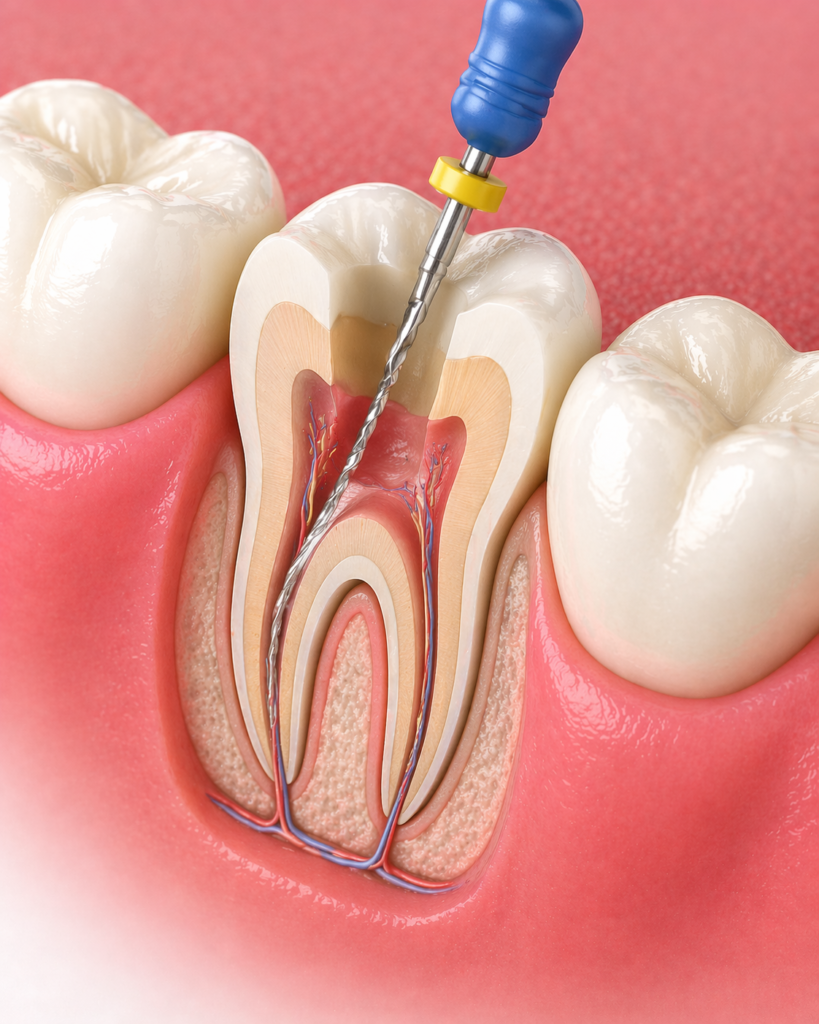
Your tooth’s been throbbing for days, you finally break down and see the dentist, and then you hear the two words nobody wants to hear: root canal. And right after the relief of finally knowing what’s wrong, the real worry kicks in. How much is this going to cost me? If you’re in Odenton, Gambrills, Crofton, or near Fort Meade, here’s the honest breakdown, including the part most price guides quietly leave out.
Here’s the quick version. Around Odenton, the root canal by itself usually runs $800 to $1,800, depending on which tooth we’re talking about. Front teeth are the cheapest, molars cost the most. But here’s the catch: most teeth also need a crown afterward, which runs another $900 to $2,000. So the real “we saved the tooth” total usually lands somewhere between $2,000 and $3,500. If you’ve got dental insurance, you’ll typically pay a good bit less than that.
Let me walk you through why the tooth itself matters so much, what’s actually hiding in the full bill, and whether saving the tooth even beats just pulling it.
Why the price swings so much: it comes down to the tooth
The biggest thing driving your root canal cost isn’t the dentist or the town you’re in. It’s which tooth needs the work. Here’s the reasoning.
Front teeth, your incisors and canines, have a single straight canal that’s easy to get to. Simple job, lowest cost. Premolars usually have one or two canals, so they sit in the middle. Molars are the tough ones. They’ve got three or four canals, they’re way in the back of your mouth, and they take the most time and skill, which is why they cost the most.
Here’s what the procedure alone usually runs by tooth type around Odenton and the rest of Maryland:
| Tooth type | Root canal (procedure only) |
| Front tooth (incisor or canine) | $800 to $1,200 |
| Premolar | $900 to $1,500 |
| Molar | $1,100 to $1,800 |
There’s one more thing that moves the price, and that’s who actually does the work. A general dentist handles plenty of root canals right in the office. But the tricky ones, like a molar with curved canals or a redo of a failed root canal, often get sent to an endodontist, who’s a root canal specialist. They tend to charge about 20 to 30% more, but that extra expertise can mean fewer headaches later.
The part most guides skip: the root canal fee isn’t the whole bill
This is where people get blindsided. The root canal itself clears out the infection, but it leaves the tooth kind of hollow and brittle. So almost every back tooth needs a crown afterward to keep it from cracking. And that crown gets billed separately. It’s a big chunk of the total.
A realistic “we saved the tooth” package usually looks like this:
| Line item | Typical cost |
| Root canal (procedure) | $800 to $1,800 |
| Exam and X-ray or CBCT scan | $50 to $250 |
| Post and core buildup (back teeth) | $200 to $500 |
| Crown | $900 to $2,000 |
| All in total (molar and crown) | $2,000 to $3,500 |
So here’s the tip that actually saves you money. When you’re comparing two quotes, always ask whether the crown is included. One office might quote you $1,100 for “a root canal” and another might say $2,600, and they could be pricing the exact same treatment. One just folded in the crown and buildup and the other didn’t. Compare the full number, not the headline.
Root canal cost with and without insurance
Without insurance, you’re looking at the full ranges above. Roughly $800 to $1,200 for a front tooth, $900 to $1,500 for a premolar, and $1,100 to $1,800 for a molar, plus the crown on top. A full molar and crown can run up toward $3,500 out of pocket.
With insurance, things get a lot easier. Most dental plans treat a root canal as a basic or major restorative procedure and cover somewhere between 50 and 80% after your deductible. That often drops your out of pocket on the root canal itself down to the $200 to $900 range. Two things to keep an eye on, though. First, your annual maximum, which usually sits between $1,000 and $2,000. A root canal plus a crown can chew through most of a year’s benefit, so timing matters. Second, crown coverage. Plans often cover the crown at a lower rate than the root canal, so check both separately.
Ways to bring the cost down
If insurance leaves a gap, you’ve got options. A lot of practices give you a 5 to 10% discount for paying in full. There’s financing through Cherry or an in house payment plan. And since a root canal and crown usually stretch across a few weeks anyway, you can sometimes split them across two calendar years and use two annual maximums instead of one.
Is a root canal cheaper than just pulling the tooth?
In the short term, pulling it wins. An extraction runs $150 to $350, way less than a root canal and crown. But that empty space rarely stays empty for long. Filling it later with an implant ($3,500 to $5,500) or a bridge usually costs more than the root canal would have in the first place. On top of that, leaving a gap lets the neighboring teeth drift and can cost you jawbone over time. So for a tooth that can actually be saved, the root canal is almost always the smarter money over a five to ten year stretch. Your dentist will give you a straight answer on whether the tooth is worth saving.
A few common questions
How much is a root canal without insurance? Around Odenton, figure roughly $800 to $1,200 for a front tooth, $900 to $1,500 for a premolar, and $1,100 to $1,800 for a molar, just for the procedure. Add a crown ($900 to $2,000) and a full molar can reach $2,000 to $3,500.
How much does a root canal cost with insurance? Most plans cover 50 to 80% of a root canal after your deductible, which usually brings your out of pocket down to about $200 to $900 for the procedure. Just watch your annual max (usually $1,000 to $2,000), since a root canal plus a crown can eat most of it in one year.
Why do molars cost more than front teeth? Molars have three or four canals and sit way at the back of your mouth, so they’re harder and take longer to treat. Front teeth have a single, easy to reach canal. More canals, more work, higher price.
Does the root canal price include the crown? Usually not. The root canal and the crown get billed separately, and most back teeth need a crown so they don’t crack. Always ask whether a quote includes the crown and buildup before you compare it to another one.
Is a root canal cheaper than pulling the tooth? Pulling costs less right now, but replacing the tooth later with an implant or bridge usually costs more than the root canal would have. For a tooth that can be saved, a root canal and crown is normally the better long term value, and you get to keep your real tooth.
The bottom line
For a tooth that can be saved around Odenton, plan on $2,000 to $3,500 for the full root canal and crown in 2026. Less for a front tooth, and often a lot less out of pocket once insurance kicks in. Your exact number comes down to which tooth it is, whether it needs a crown, and what your coverage looks like.
The only way to get your real number is an exam and an X-ray. At OraCore Dental in Odenton, we’ll take a look, tell you straight whether we can treat it here or you’d be better off with a specialist, check your benefits, and hand you a clear itemized plan before we start anything.
📞 Tooth pain that just won’t quit? Call OraCore Dental and book your evaluation. We take care of folks all over Odenton, Gambrills, Crofton, Severn, and Fort Meade.